
Support in education – Graduated response
Supporting children and young people to succeed in schools and settings.
What is SEND (Special Educational Needs and/or Disabilities)?
In any classroom, there are children learning at different rates and in different ways. Teachers will plan their lessons and choose different types of lesson materials to help each child learn to the best of their ability.
If a child is consistently making slower progress than expected – and a gap has opened up between them and their peers – then they may have some special educational needs and/or disabilities.
Deciding whether a child or young person has SEND
If SEND is suspected, then school will gather information to get a clear picture of the child’s or young person’s abilities and needs. This should include the views of the child/young person and their parents/carers.
Parents and carers are an important part of the process. In some cases, parents or carers are the first to notice that their child or young person may have SEND. This could be about something other than their schoolwork. For example, they may be concerned that their child or young person has no friends, that they are increasingly anxious about school, or that they ‘explode’ as soon as they get home.
Putting the right support in place
Once there is a clearer picture of the child or young person’s needs, the school may:
- Decide that they do not have SEND – but offer some extra help through their pastoral support system or by making some changes to classroom teaching. Sometimes this is all that is needed to get things back on track.
Or
- Provide some additional support set out in a SEND support plan. Parents/carers must be notified if this is the case.
The graduated response
For some children, SEND is identified at an early age. They may have complex developmental and/or learning needs identified at birth or within the early years. When this happens, health service practitioners will make sure that the Local Authority is aware of the child’s needs. This helps with planning ahead to make sure the child’s needs are met when they start nursery or school. As long as parents agree, advisory or specialist teachers, educational psychologists, and the Portage Service may become involved with supporting the child and family.
Click below for more information on the Local Offer about Portage:
However, for lots of children and young people difficulties become evident only as they develop.
The graduated response is all about children and young people getting the right help, in the right way, from the right person at the right time. It aims to stop small problems turning into big ones. Schools and settings receive funding so that they can put some support in place when it is needed.
Sometimes this will involve working with other services who know the child or young person. A practitioner such as a speech and language therapist, educational psychologist, specialist teacher or a family worker can make useful contributions to understanding the child or young person’s needs and developing a good support plan.
When a child or young person is getting help in school as part of the graduated response, this will be summarised in a SEND support plan.
You can find out more about how the graduated response is aimed at all educational providers and settings supporting Rotherham children and young people aged 0-25 years. A booklet which outlines the provision and support that Rotherham Council expects to be in place in all educational settings which support children and young people with SEND can be downloaded from the link below:
SEND support plans
This is a plan which sets out what outcomes the child or young person needs (and wants) to achieve and what support will be put in place to help them do this.
The plan should be clear about what form the extra help or adaptations will take. Here are some examples of the kind of support that may be offered:
- Adjustments to the school environment, e.g. creating a quiet place to be or installing safety catches on doors
- Changes to the way the child is taught, e.g. adapting materials, small-group work, some individual support or a adapted learning programme
- Adjustments to school policies, e.g. exempting your child from homework or some specific relaxation of school rules, e.g. school uniforms
- Help with personal care, e.g. dressing, toileting or eating
- Support at break times, e.g. a ‘circle of friends’, a library pass, or access to a staffed base
- A member of staff the child knows well to ‘meet and greet’ them in the mornings to reduce their anxiety about coming into school
- Training, advice and support for school staff who work with the child
Parents/carers should be offered the opportunity to meet with school staff to review their child or young person’s progress at least 3 times a year. For as long as the child or young person needs it, the school should follow a simple support cycle:
- Assess: Working out what the child needs to achieve next
- Plan: Putting together a support plan
- Do: Putting the plan into action
- Review: Checking how it has worked
Education, health and care plans
For the vast majority of children and young people, a SEND support plan is all that is required to meet their needs. However, a small number require more support than their school or other setting can provide. These individuals may be referred in for a full assessment of their education, health and care needs under the Children and Families Act 2014. Following this assessment, the Local Authority will decide whether the child or young person requires an education, health and care plan (EHCP). This sets out their individual needs in detail, the provision that is needed to meet these and who will deliver this. An EHCP has a legal status.
For more information about EHCPs, click here:
Specialist provision
All children and young people with SEND are entitled to a mainstream education. This means that all education providers must support children and young people with SEND. In most cases they can do this through a SEND support plan. If this is not sufficient, an EHCP may be put in place.
Some children with EHCPs may need to attend specialist provision. This may be a mainstream school with a resource centre that specialises in their type of need or a special school.
Click on the link below for more information about resourced provisions in Rotherham.
The EHC assessment process will help to identify the right kind of educational placement to meet each child’s individual needs.
Support for different types of SEND
There are 4 main categories of special educational need. These are set out in the SEND Code of Practice:
SEND code of practice (gov.uk)
Individual children or young people often have needs that cut across all these areas and their needs may change over time. Each individual has their own personality, strengths, aspirations and challenges and they will need a package of support which takes all of these into account.
Ranges of need
Not all pupils with the same type of SEND will have the same level of need. In some cases, a pupil’s SEND needs can be met with reasonable adjustments within a mainstream setting. Another may need highly specialist provision. Many will fall in a range somewhere between these two extremes.
RMBC have produced guides to support schools in assessing and meeting the needs of pupils with SEND. They have prepared threshold guides for different areas of need using numbered ranges from 1 to a maximum of 7.
They describe the pupil’s needs and provide suggestions for the types of interventions that could help. You can view or download the relevant documents from the Local Offer under each area of need.
RMBC have also produced general guidance relating to the threshold documents. You can view or download these by clicking on the links below:
Find online SEND resources for schools on the SENDCO Rotherham website:
Communication and interaction
Children and young people with speech, language and communication needs (SLCN) have difficulty in communicating with others. This may be because they may struggle with saying what they want to, understanding what is being said to them or making sense of the social rules of communication.
Click on the link below to view or download the threshold guidance for supporting pupils with a range of communication and interaction needs.
Guidance for children and young people with Speech, Language and Communication Needs (PDF)
For more information about SLCN – and how schools in Rotherham can support children and young people with SLCN – click below
Speech and language (SENDCOrotherham.co.uk)
This will take you to Rotherham’s online SEND resources for schools.
Children and young people with an autism spectrum disorder are likely to have particular challenges with social interaction. They may also experience difficulties with language, communication and imagination, which can impact on how they relate to others.
Click on the link below to view or download the threshold guidance for supporting pupils with a range of communication and interaction and autism spectrum disorders.
Communication and Interaction/ Autism Spectrum Disorders (PDF)
For more information about SLCN – and how schools in Rotherham can support children and young people with SLCN – click below
Social communication (SENDCOrotherham.co.uk)
This will take you to Rotherham’s online SEND resources for schools.
Cognition and learning
Support for learning difficulties may be required when children and young people learn at a slower pace than their peers, even with appropriate teaching to meet their needs.
Learning difficulties cover a wide range of needs, including moderate learning difficulties (MLD), severe learning difficulties (SLD), where children are likely to need support in all areas of the curriculum together with associated difficulties with mobility and communication, through to profound and multiple learning difficulties (PMLD), where children are likely to have severe and complex learning difficulties as well as a physical disability or sensory impairment (Source: SEND Code of Practice).
Specific learning difficulties (SpLD), affect one or more specific aspects of learning. This includes a range of conditions such as dyslexia, dyscalculia and dyspraxia.
Click on the link below to view or download the threshold guidance for supporting pupils with a range of cognition and learning needs.
Using the SEND Thresholds (Cognition and Learning Needs) Guidance 2025 (PDF)
For more information about how schools can help children and young people with cognition and learning needs, click below
Cognition and learning (SENDCOrotherham.co.uk)
For information on support for motor co-ordination difficulties and dyspraxia (also known as developmental co-ordination disorder) in school, click below
Physical needs (SENDCOrotherham.co.uk)
These links will take you to Rotherham’s online SEND resources for schools.
Social, emotional and mental health (SEMH)
Children and young people may have a wide range of social and emotional needs which show themselves in many ways. These may include becoming withdrawn or isolated, as well as displaying challenging, disruptive or disturbing behaviour. These behaviours may reflect underlying mental health difficulties such as anxiety or depression, self-harming, substance misuse, eating disorders or physical symptoms that are medically unexplained. Other children and young people may have disorders such as attention deficit disorder, attention deficit hyperactive disorder or attachment disorder.
Click on the link below to view or download the threshold guidance for supporting pupils with a range of social, emotional & mental health needs.
Social, Emotional and Mental Health Needs (PDF)
For more information about how schools can help children and young people with SEMH, click below
Understanding SEMH needs (SENDCOrotherham.co.uk)
This will take you to Rotherham’s online SEND resources for schools.
Physical and sensory
Some children and young people require special educational provision because they have a disability which prevents or hinders them from making use of the educational facilities generally provided. These difficulties can be age related and may fluctuate over time.
Physical disabilities
Some children and young people with a physical disability (PD) require additional ongoing support and equipment to access all the opportunities available to their peers.
Click on the link below to view or download the threshold guidance for supporting pupils with a range of physical and medical needs.
Guidance for Children and Young People with Physical and Medical Needs (PDF)
For more information about how schools can help children and young people with physical disabilities, click below
Physical needs (SENDCOrotherham.co.uk)
This will take you to Rotherham’s online SEND resources for schools.
Sensory impairments
Some children and young people with vision impairment (VI), hearing impairment (HI) or a multi-sensory impairment (MSI) will require specialist support and/or equipment to access their learning. Children and young people with an MSI have a combination of vision and hearing difficulties.
Click on the link below to view or download the threshold guidance for supporting pupils with a range of visual impairments.
Sensory and/or Physical and Medical Needs – Visual Impairment (PDF)
Click on the link below to view or download the threshold guidance for supporting pupils with a range of hearing impairments.
Sensory and/or Physical and Medical Needs – Hearing Impairment (PDF)
Click on the link below to view or download the threshold guidance for supporting pupils with a range of with dual sensory impairments, which may also be referred to as multi-sensory impairment or deaf blindness.
Guidance for Children and Young People with Dual Sensory Impairment (PDF)
For more information about how schools can help children and young people with sensory impairments, click below for support with visual impairments
Visual needs (SENDCOrotherham.co.uk)
or below here for support with hearing impairments
Hearing needs (SENDCOrotherham.co.uk)
This will take you to Rotherham’s online SEND resources for schools.
Sometimes children and young people with MSI will also have sensory differences (see below)
Sensory differences
Some children and young people will have sensory differences. This means that their brains interpret the information coming from their sensory receptors (including from their eyes, ears, taste buds and muscles) in a way that is different to most people. This can create challenges for them, especially at school.
For more information about how schools can help children and young people with sensory differences, click below
Sensory needs (SENDCOrotherham.co.uk)
This will take you to Rotherham’s online SEND resources for schools.
Further information about sensory needs on the Local Offer
For more general information and advice on the Local Offer about support for sensory needs in Rotherham, click below
Support for medical needs
Some children and young people attending early years settings and schools will have long-term health conditions.
Often these can easily be managed without the need for an individual healthcare plan, but for some children and young people a healthcare plan is required to make sure that their medical needs are met during their time at nursery or school.
A decision on whether a plan is needed would normally be based on advice from health practitioners and be made in consultation with parents/carers and, where possible, the child or young person themselves.
Individual healthcare plans
Ensuring that there is an individual healthcare plan when a child or young person needs one is the responsibility of the school or setting but it is normally written in partnership with parents/carers (and ideally the child or young person). It is based on the advice given by health practitioners (likely to be a GP, hospital doctor or nurse) and should be updated at least annually. For those children and young people with a high level of medical need, a special education nurse – or a nurse linked to the specialist team for their condition(s) – is likely to be involved and may actually write the plan.
Medical Home Tuition
Sometimes children or young people cannot go to school for a while because of their health needs. It is important to make sure these children still get a good education while they are at home. Schools, doctors, families, and the council work together to do this.
The guidance below includes:
- what everyone needs to do
- how to ask for help
- how to plan for the child to go back to school when they feel better.
RMBC Medical Home Tuition Guidance 2025-26 (PDF)
You can also read this document as a simple web page:
RMBC Medical Home Tuition Guidance 2025-26 (htm)
The document contains forms for parents/carers and schools to sign when making a medical home tuition arrangement.
You can download editable word document versions of these forms below:
Preparing for adulthood
As young people grow and mature they will often be able to take more responsibility for managing their own health needs. This means that school staff no longer need to follow an individual healthcare plan because the young person has become able to monitor and manage their own condition. However, some young people with multiple or more complex needs may require a plan right up until the time they leave.
For those young people attending a school, the special educational nurses remain available to support with the writing of individual healthcare plans until they finish school at the age of 18 (or 19 for special schools).
For those young people attending a post 16 college, the health practitioners working with them are available to provide advice and support at the point of transition.
More information and advice
Click below for more information about how health services and schools in Rotherham can help children and young people with long-term conditions.
Health needs (SENDCOrotherham.co.uk)
This will take you to Rotherham’s online SEND resource for schools. The resource also contains links to information about school nursing and condition specific health teams.
All schools are required to have their own policy on supporting pupils with medical conditions. This will be based on national guidance for schools, together with some suggested templates for writing individual healthcare plans.
The links below include Department for Education guidance for pupils with medical needs in school and those who cannot attend school because of health needs.
Supporting pupils with medical conditions at school (gov.uk)
Arranging education for children who cannot attend school because of health needs (gov.uk)
Support for mental health needs
Some children and young people attending schools will have mental health needs.
There is information above on support for Social, Emotional and Mental Health (SEMH) needs with a link to guidance for schools on the SENDCO Rotherham website:
Support for different types of SEND
There is also advice on the Emotional wellbeing and mental health in the Health and wellbeing section of the Local Offer
Emotional wellbeing and mental health
Some schools in Rotherham are also involved with the ‘With Me in Mind’ project which means that they have access to a team of support workers based in schools.
With Me in Mind
With Me in Mind works in partnership with local schools, colleges and academies. These are in Rotherham, Doncaster and North Lincolnshire. They work with children and young people in participating primary and secondary schools. They work with children aged five and above, including young people up to the end of Year 13. They support children and young people with their emotional and mental health.
What do they do in schools?
With Me in Mind is a Mental Health Support Team. Mental Health Support Teams support schools in three ways:
- Offering consultation, advice and signposting to school staff regarding the individual emotional health needs of children in their settings.
- Delivering 1:1 evidence-based interventions for children with mild to moderate mental health needs.
- Supporting schools to develop a whole school approach to mental health. This also includes delivering classroom sessions, workshops, parent sessions, teacher training, and so on.
The team aim to enhance support already in place from school counsellors, nurses, educational psychologists and the voluntary sector to treat those with mild to moderate mental health needs in school.
The team can also help children and young people with more severe needs to access the right support and provide a link to specialist NHS services.
They can help with low mood, worries, fears sleep, and behavioural and emotional difficulties you may be experiencing.
They can also help with education around things like
- Resilience and assertiveness
- Managing exam stress
- Social media
- Transitions
- Guided self-help
- Helpful resources and local links for accessing more support
To access the service, ask one of your teachers or a member of school staff who can direct you to the With Me in Mind teams
List of schools involved
Many schools across Rotherham are now part of the With Me In Mind project.
See the flyer and lists below for more details:
With Me in Mind schools list (pdf)
Primary schools
- Aston Hall Junior and Infant School
- Aston Lodge Primary School
- Aughton Primary Academy
- Badsley Primary School
- Blackburn Primary School
- Bramley Grange Primary School
- Bramley Sunnyside Junior School
- Brinsworth Whitehill Primary School
- Brookfield Primary Academy
- Canklow Woods Primary School
- Crags Community School
- Eastwood Village Primary School
- Foljambe Primary School
- Greasbrough Primary School
- Herringthorpe Junior School
- Highfield Farm Primary School
- Kilnhurst St Thomas’ Primary Academy
- Maltby Lilly Hall Academy
- Maltby Manor Academy
- Maltby Redwood Academy
- Monkwood Primary School
- Ravenfield Primary School
- Rawmarsh Ashwood Primary School
- Rawmarsh Sandhill Primary School
- Rockingham Junior and Infant School
- Roughwood Primary School
- Sitwell Junior School
- St Joseph’s Catholic Primary School
- St Ann’s Primary School
- Swinton Queen Primary School
- Thorpe Hesley Primary School
- Thrybergh Primary School
- Thrybergh Fullerton Primary Academy
- Trinity Croft Primary Academy
- Wales Primary School
- Wath Central Primary School
- Wath Victoria Primary School
- Whiston Worrygoose Junior & Infant School
- Wickersley Northfield Primary School
Joining from January 2026 (Wave 14)
More schools are joining the project starting from January 2026. These are known as Wave 14 settings:
Wave 14 Rotherham Schools and Colleges flyer
- Anston Brook Primary School
- Anston Park Junior School
- Aston All Saints Primary School
- Brampton ‘The Ellis’ Primary School
- Brinsworth Manor Infant School
- Brinsworth Manor Junior School
- Coleridge Primary School
- Dinnington Community Primary School
- East Dene Primary School
- Flanderwell Primary School
- High Greave Infant School
- Kiverton Park Meadows Junior School
- Listerdale Primary Academy
- Our Lady & St Joseph’s Primary School
- Rawmarsh Ryecroft Infant School
- Redscope Primary School
- Springwood Primary Academy
- St Mary’s Catholic Primary School (Maltby)
- Swallownest Primary School
- Swinton Fitzwilliam Primary School
- Thurcroft Infant School
- Thurcroft Junior Academy
- Todwick Primary School
- Wath C of E Primary School
- Waverley Primary Academy
- Wentworth C of E Junior and Infant School
- Whiston Junior and Infant School
Secondary schools
- Aston Academy
- Brinsworth Academy
- Clifton Community School
- Dinnington High School
- Maltby Academy
- Oakwood High School
- Rawmarsh Community School
- Saint Pius X Catholic High School
- St Bernard’s Catholic High School
- Wales High School
- Wath Academy
- Wickersley School and Sports College
- Wingfield Academy
- Winterhill School
Others
- Aspire PRU
- Elements Academy
- Newman School
- The Willows School
- Thomas Rotherham College
- Rotherham College (joining from January 2026)
eClinics
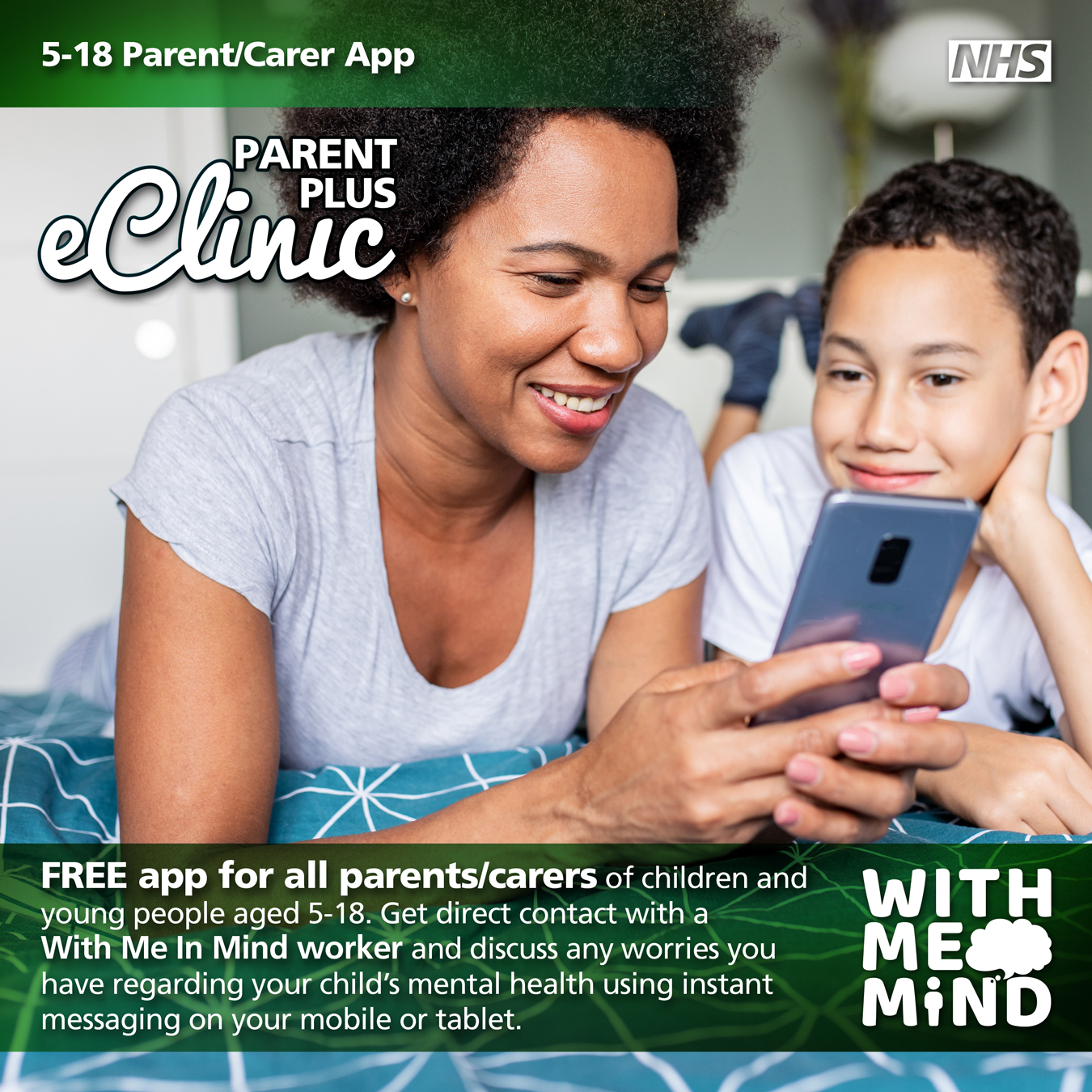
With Me In Mind has an eClinic where you can talk to a worker using instant messaging. They have eClinics for 11 to 19 year olds and for parents/
carers. Use the QR codes on the downloadable flyer below to download your FREE app and get an online appointment.
For more information about the free Parent Plus eClinic app for all parents and carers of children and young people aged 5 to 18, see the downloadable flyer below.
Useful websites and contacts
KOOTH is aimed at all young people aged 10 to 25 and provides online information and support, including the option of 1:1 online chat with a trained counsellor.
Rotherham Child and Adolescent Mental Health Service (CAMHS) provides advice and support to children and young people aged 5 to 19 years as well as to their families, carers and professionals working with them.
Childline is here to help anyone under 19 in the UK with any issue they’re going through. Children and young people can talk about anything. Whether it’s something big or small, they have trained counsellors to offer support. Childline is free, confidential and available any time, day or night.
YoungMinds are a mental health charity for children, young people and their parents, making sure all young people can get the mental health support they need.
Emotional based school avoidance (EBSA)
Emotionally Based School Avoidance (EBSA), also known as School Refusal, School Avoidance and School Reluctance, is a term which may be used to describe children (or young people) who do not attend an educational setting due to emotional factors or experiences. It is important to note that EBSA is different from school absence which is due to physical illness or truancy.
For more details on EBSA, see the downloadable guidance below:
What is an Education, Health and Care Plan (EHCP)?
Education, Health and Care Plans explained
How do I get an EHCP?
EHC plans are drawn up by the Local Authority after an EHC needs assessment. You, your child’s education provider, a professional involved with your child (e.g. social worker) or your child if they are aged over 16, can ask your local authority to carry out an assessment.
If the special educational provision being made for a child or young person by an early years setting, school or college is not enabling the child or young person to make adequate progress then it may be necessary to request an Education, Health and Care (EHC) Assessment.
All involved, parent/carers, settings and support services and (if appropriate) young people should work together to make the request to the Local Authority.
In Rotherham, EHC needs assessment requests are made through the EHC Hub. You can click below for more information on the Local Offer about the EHC Hub:
Rotherham Education Health Care (EHC) Hub
Click on the video link below for more information about the 20-week assessment process in Rotherham:
What does an Education, Health and Care Plan (EHCP) look like?
An EHCP has the following sections:
Section A
The views, interests and aspirations of the child and his or her parents or the young person.
This may include the following details about the child or young person:
- aspirations and goals
- play
- health
- schools
- independence skills
- future planning
- background history
- means of communication
Section B
The child or young person’s special educational needs (SEN)
This includes all of the child or young person’s special educational needs. SEN may include needs for health and social care provision where this educates or trains the child or young person.
Section C
Any health needs identified through the EHC needs assessment which relate to the child or young person’s SEN.
The Integrated Care Board (ICB) may also choose to specify other health needs related to a long-term condition, not their SEN needs.
Section D
Any social care needs identified through the EHC needs assessment which relate to the child or young person’s SEN.
The Local Authority may choose to specify other social care needs not linked to SEN, such as reference to a child in need or child protection plan.
Section E
The SMART outcomes sought for the child or the young person. Even from the earliest of years, outcomes must consider preparation for adulthood themes, which are clearly linked to the achievement of the child or young person’s aspirations in section A. The EHC plan should also identify the arrangements for the setting of shorter term targets by the early year’s provider, school, college or other education or training provider.
This section may include:
- a range of outcomes with agreed steps and timescales, recognising that it is only the education and training outcomes that will determine if a plan is ceased for young people over 18
- a distinction between outcomes and provision
- arrangements for monitoring progress
- forward plans for key transition points, such as, moving school or transition to adulthood
Section F
The special educational provision required by the child or young person.
Provision must be specified for every need specified in section B – including health and social care where the provision educates or trains a child.
Provision should be detailed and specific. It may include
- the hours and level of support
- facilities and equipment required
- whether residential accommodation is appropriate
- where there is a personal budget, the outcomes to which it is intended to contribute.
Section G
Any health provision reasonably required by the learning difficulties or disabilities which result in the child or young person having SEN. Where an Individual Health Care Plan is made for them, that plan should be included.
It should be made clear how provision will contribute to outcomes and how advice was sought to inform the provision specified.
Provision should be detailed and specific. It may include the following details
- specialist support and therapies
- other health care provision, where required, not linked to their SEN.
Section H1
Any social care provision which must be made for a child or young person under 18 resulting from section 2 of the Chronically Sick and Disabled Persons Act (CDSPA) 1970.
Where a social care plan is made it should be included. Provision should be detailed and specific. It should be made clear how provision will contribute to outcomes and how advice was sought to inform provision specified. The EHC must specify the services assessed as being necessary to meet the needs of a disabled child, or section 2 of the CDSPA.
Section H2
Any other social care provision reasonably required by the learning difficulties or disabilities which result in the child or young person having SEN. This will include any adult social care provision being provided to meet a young person’s eligible needs (through a statutory care and support plan) under the Care Act 2014.
Social care provision reasonably required may include provision identified through early help, child in need and safeguarding assessment, which are not provided under CSDPA. For children under 18 this could include residential short breaks and services provided to children arising from their SEN but unrelated to a disability. Any required adult social care provision (for young people over 18).The Local Authority may also choose to specify in section H2 other social care provision reasonably required by the child, not linked to their learning difficulties or disabilities.
Section I
The name and type of education setting to be attended by the child or young person, such as a school, maintained nursery school, post-16 institution or other institution. Or, where the name of a school or other institution is not specified in the EHC plan, the type of school or other institution to be attended by the child or young person.
Details must be included only in the final plan, not the draft EHC plan sent to the child’s parent or to the young person.
Section J
Where there is a personal budget, the details of how this will support particular outcomes, the provision it will be used for including any flexibility in its usage and the arrangements for any direct payments for education, health and social care. The special educational needs and outcomes that are to be met by any direct payment must be specified.
This section should provide detailed information on any Personal Budget that will be used to secure provision in the EHC plan. It should set out the arrangements in relation to direct payments as required by education, health and social care regulations. The SEN needs and outcomes that are to be met by any direct payment must be specified.
Section K
The advice and information gathered during the EHC needs assessment or review must be attached (in appendices).
There should be a list of this advice and information.
Legal requirements
An ECHP is a legal document describing a young person’s needs; what should happen to meet those needs and the suitable educational placement.
The following acts, regulations and guidance relate to the legal requirements on Local Authorities, families and those working with children with SEND in terms of EHCPs:
Children and Families Act 2014
Part 3 of the Children and Families Act 2014 covers legislation relating to Special Educational Needs and Disabilities (SEND).
The sections 37 to 50 are particularly relevant to EHCPs:
Part 3: Education, health and care plans (legislation.gov.uk)
The Special Educational Needs and Disability Regulations 2014
Part 2 covers regulations about children and young people with SEND. Sections 5 to 31 are particularly relevant to EHCPs.
Part 2: Children and young people with special educational needs (legislation.gov.uk)
SEND code of practice: 0 to 25 years
There is further guidance on EHCPs throughout the SEND Code of Practice which is published on the gov.uk website.
Right to appeal
A child/young person and their family may appeal to the Special Educational Needs and Disability (SEND) Tribunal if they disagree with a decision the local authority has made about a child or young person’s education, health and care (EHC) needs or plan, or if they:
- refuse to carry out an EHC assessment or reassessment
- refuse to create an EHC plan after carrying out an assessment or reassessment
- refuse to change the sections of an existing EHC plan which are about education (sections B, F and I)
- decide you or your child does not need an EHC plan any more (ceasing an EHCP)
In the first instance, parents are directed to contact their EHCP Coordinator. The EHCP Coordinator will have detailed knowledge about the statutory processes aligned with the children and young people they are working on behalf of, and also why and how decisions have been made in particular circumstances and those endorsed by the SEND Panel.
Should parent/carers wish to formally challenge a panel decision, details on how to do so are sent to parent/carers in a letter following the decisions outlined above. This may involve contacting Rotherham SENDIASS, Mediation Services or by appealing to the SEND Tribunal.
Mediation
Mediation is a service for parents, carers and young people whose children have or may have SEND and they
- have been declined an EHC assessment,
- have been declined the issuing of an Education, Health and Care (EHC) Plan,
- have an EHC Plan but disagree with the content, or
- have been advised that an EHC Plan will be ceased.
In most cases, parents, carers and young people must consider mediation before appealing to the Tribunal and they must discuss this with the mediation service. However, if the appeal would only relate to the named school or setting in the EHC Plan (section I), then parents can go straight to appeal.
Mediation in Rotherham
From 1st April 2025, Collis Mediation will be providing mediation services for Rotherham families.
Collis Mediation Ltd is an impartial and independent organisation who offer this service free to those with parental responsibility. The service allows an expert to chair a mediation meeting. This gives families an opportunity to resolve disputes and it enables them to be fully and equally involved in decisions that will affect them and their children.
Contact details
Collis Mediation Ltd
Tel: 07715 958290
Email: info@collismediationltd.com
SEND Appeal (collismediationltd.com)
How mediation works
The mediator is independent and impartial. They have no involvement with the case or the outcome. They will have extensive knowledge of special educational needs and will be trained in working with people to help them in communicating and resolving disagreements.
If families decide to go ahead with mediation, it should take place within 30 days. If mediation cannot take place within 30 days, on a matter that can be appealed to Special Educational Needs Disability Tribunal (SENDIST), then the mediator must issue a certificate within 3 days. Families then have the option of appealing immediately or waiting for mediation to take place.
Agreeing or declining to take part in mediation does not affect anyone’s right to appeal to the Special Educational Needs Disability Tribunal (SENDIST). If a family do not want to go into mediation, in most cases, they must still get a certificate from the mediation service to appeal.
Parents, carers and young people can use the mediation provider to help resolve disagreements about Education, Health and Care (EHC) needs assessments and planning, as well as other issues before making an appeal to Special Educational Needs Disability Tribunal (SENDIST). Mediation can be very successful and means families may not need to go to Special Educational Needs Disability Tribunal (SENDIST). But if families are not happy with the outcome of mediation, they can still make an appeal after mediation.
- All the mediation work is free to families.
- The service is for children and young people aged 0 to 25 and their parents and carers.
- Mediation is quick and informal and helps the participants to clarify, narrow down and often resolve disagreements so that you do not have to go to Special Educational Needs Disability Tribunal (SENDIST).
- Mediation and disagreement resolution can be arranged between parents and the local authority and invite contribution from schools and colleges.
- Health and Social Services can also be involved.
- Mediation meetings are usually via an online platform which is very easy to use.
- The impartial mediation service helps everybody prepare for the meeting.
- Mediation meetings take place within 30 days of the mediation service notifying the local authority of your request.
- Mediation meetings are an opportunity to openly discuss concerns with the local authority.
- The mediator makes sure everybody has the chance to listen, speak, and be heard.
- At the end of the Mediation meeting, the mediator will ensure the outcomes are accurate.
- The outcomes and certification are then issued to the LA, young people, parents, carers and anybody who it is consented to be shared with.
- The outcomes are legally binding.
- Families can go on to Special Educational Needs Disability Tribunal (SENDIST) after mediation if they wish
You can read more about SEND Mediation here:
SEND Mediation (collismediationltd.com)
You can watch the Easy Access Information Video by Collis Mediation here:
You can make a referral to the mediation service here:
Appeal Request Form (collismediationltd.com)
For more information about appealing an EHC plan decision, click below
Appeal an education, health and care (EHC) plan decision (www.gov.uk)
If you want to appeal the sections of the EHCP which relate to health and/or social care, you can do this too through the tribunal (although the tribunal’s decision is not binding on these).
For more information on extended appeals, click below
SEND Tribunal: single route of redress national trial (gov.uk)
The Annual Review Process
The Education, Health and Care Plan (EHCP) must be reviewed at least once a year. It will usually be reviewed more frequently than this for pre-school children.
This is a chance for everyone involved in supporting your child to check how well they are progressing and whether anything needs to be changed. At the end of the review the Local Authority may make changes to the plan, end it or leave it unchanged.
The EHCP will remain in place until the child or young person leaves education or the Local Authority decides that they no longer need the plan to help them in their education. If you move to another Local Authority the plan will be transferred.
From Year 9 onwards Annual Reviews must include a focus on preparing for adulthood including employment, independent living and participation in society.
For more information, click below
Making formal processes more child and young person friendly
Although an EHCP review is a formal process, it is important that review meetings are run in a way that is person friendly and enables the child or young person to participate in decision making.
Please click on the link to Rotherham’s online resource for schools for further information on how this can be achieved:
Post-16 support information
The support that young people with SEND receive from age 16 should encourage them to make decisions and develop skills and qualifications that will enable them to achieve their aspirations and move into adulthood with confidence.
19 to 25 year olds’ entitlement to EHC plans
It is recognised that some young people with special educational needs and disabilities will need longer than this to complete and consolidate their education and training. The length of time will vary according to each young person, and judgements on when to stop or maintain a plan must be made on a case-by-case basis and in accordance with the statutory tests and processes.
For more information, click below
SEND: 19- to 25-year-olds’ entitlement to EHC plans (www.gov.uk)
Personal budgets
If a parent or young person requests a personal budget, the local authority must consider this in relation to an EHCP. In some circumstances this may include making direct payments.
A personal budget for special educational provision can only be used for delivering some or part of the provision specified in Part F of an EHC plan.
IPSEA (Independent Provider of Special Education Advice) have more information on personal budgets and direct payments on their website:
Personal budgets and direct payments | (IPSEA) Independent Provider of Special Education Advice
Education Other Than At School or College (EOTAS or EOTAC)
EOTAS is where a child or young person with an education health, and care plan (EHCP) can receive educational provision despite not being able to attend an educational setting.
For more details on EOTAS and EOTAC, see the downloadable guidance below:
Guidance on Education Other Than At School or College (EOTAS / EOTAC)
Eligibility
EOTAS will only be provided if the following are met:
- The child or young person has an Education, Health and Care Plan (EHCP).
- The local authority are satisfied that it would be inappropriate for any special educational provision that has been decided is needed for the child or young person to be made in any school. And it would be inappropriate for any part of the provision to be made in any school.
The Special Educational Needs service will provide an EOTAS package where its deemed ‘inappropriate’ for a child or young person to attend school. Therefore, the expectation is that a child should attend a school or college setting, unless it is inappropriate for them to do so.
This is different to Elective Home Education (EHE) where families choose to educate their child at home. For more information on home education in Rotherham, click on the link below:
Educating your child at home – Rotherham Metropolitan Borough Council
Application process
There are several routes to approval for an EOTAS package
Statutory assessment
It may be indicated that an EOTAS package is the best option during statutory assessments. The Local Authority may determine that it is inappropriate for the child or young person to attend an educational setting. The allocated SEND coordinator will present the case for approval at the SEND panel.
EHCP Annual Review
It may be indicated that an EOTAS package is the best option during the annual review for a child or young person’s EHCP. The Local Authority may determine that it is inappropriate for the child or young person to attend an educational setting. The allocated SEND coordinator will present the case for approval at the SEND Placement and Provision panel.
Parental request
Parents may notify the local authority that they would like to educate their child at home. Firstly, it must be clear to everyone involved whether the request is for Elective hOme Education (EHE) or Education Other Than At School or College (EOTAS/EOTAC). There are key differences between these two options.
- EHE: Parents or carers are responsible for arranging suitable education and funding it themselves.
- EOTAS/EOTAC: The Local Authority is responsible for providing the funding for suitable education.
Parents can request an EOTAS package
- In response to a proposed EHCP
- During a review of an EHCP
- In writing to the Local Authority
The allocated SEND coordinator will present the case for approval at the SEND Placement and Provision panel
Assessment for approval
When making decisions about whether or not to approve EOTAS, the SEND Placement and Provision Panel will consider the following:
- Evidence, information and views submitted by the child or young person, and their parents or carers
- Information collated by the Local Authority from professionals and agencies, such as,
- The child or young person’s EHCP
- Annual Review information
- Attendance and behaviour logs
- Reports or letters from professionals working with the child or young person
- School or college consultation responses
They will discuss the above information with reference to the specific circumstances of the child or young person, such as,
- Their and their parent or carer’s wishes
- Their background and medical history
- Their educational needs (section B of EHCP)
- The provision required to meet their needs (section F of EHCP)
- The facilities that can be provided by possible educational settings
- The facilities that could be provided by an EOTAS/EOTAC package
If the SEND Placement and Provision Panel do not approve an EOTAS package and the parent or carer still want their child to be educated at home, then the child would be considered as electively home educated. The parents would then be responsible for arranging suitable education.
Home education and special needs – Rotherham Metropolitan Borough Council
Delivering an EOTAS/ EOTAC package
Once the SEND Placement and Provision Panel has decided that there are no educational settings appropriate for a child, the SEN EOTAS advisor will be informed. They will work with an educational psychologist and the allocated SEND coordinator in partnership with families to prepare a suitable EOTAS/EOTAC package.
The package will provide the child or young person with education that is suitable for their age, ability, aptitude and special educational needs. It will decide how the programme is to be delivered and how it will be monitored and reviewed. It may also specify how it will help the child or young person return to an education setting. It should also consider the efficient use of public resources.
There are more details on EOTAS/EOTAC packages, in the downloadable guidance below: Guidance on Education Other Than At School or College (EOTAS / EOTAC)
Rotherham Education Health Care (EHC) Hub
Rotherham Council has partnered with Idox’s Open Objects to provide the new Rotherham EHC Hub – a secure online platform that manages all aspects of the EHC process.
Rotherham EHC Hub (ehcp.rotherhamcouncil.org.uk)
The Hub helps in the Council’s aim to create a person-centred approach for children and young people with Special Educational Needs. It enables better collaboration between professionals and families, and improved information sharing at each stage – from the 20-week assessment and planning pathway, through to EHC Plans and reviews.
The Hub is used by everyone who contributes to EHCPs – including children and young people, parents and carers, schools, health and other professionals.
To protect personal data, security features are built-in to the hub, including a verification check by phone. Access to the system is via a two-factor authentication process, similar to the systems used by on-line banking.
If you have any problems accessing the new hub, or have any further questions please contact the Council’s EHCP Team by email on hubhelp@rotherham.gov.uk
See the EHC Hub Frequently Asked Questions (FAQs)
RMBC Guidance for Early Help and Social Care Advice to be submitted via The Rotherham EHC Hub
RMBC Guidance for Health Advice to be submitted via The Rotherham EHC Hub
Education, Health and Care (EHC) Assessment
If you wish to make a request for a statutory EHC Assessment please use the Rotherham Education, Health and Care Hub (rotherhamcouncil.org.uk)
Locality model for Rotherham
Rotherham Locality Model Overview
The new locality model for the EHC team divides Rotherham into three areas based on the catchment areas of the following secondary schools
Locality 1: Central
- Clifton Community School
- Oakwood High School
- St Bernard’s Catholic High School
- Wickersley School and Sports College
- Winterhill School
Click here for more information about the education settings included in locality 1:
Email: Locality1-EHCPTeam@rotherham.gov.uk
Locality 2: North
- Rawmarsh Community School
- Saint Pius X Catholic High School
- Swinton Academy
- Thrybergh Academy & Sports College
- Wath Academy
- Wingfield Academy
Click here for more information about the education settings included in locality 2:
Email: Locality2-EHCPTeam@rotherham.gov.uk
Locality 3: South
- Aston Academy
- Brinsworth Academy
- Dinnington High School
- Maltby Academy
- Wales High School
Click here for more information about the education settings included in locality 3:
Email: Locality3-EHCPTeam@rotherham.gov.uk
For any other enquiries, contact the Education, Health and Care Planning Team on 01709 822660
If you are unsure which locality team you need to contact, please email all three teams and include details of the setting you or your child or young person currently attend.
Locality One: Central
Contact details:
Email: Locality1-EHCPTeam@rotherham.gov.uk
Locality Lead Manager: David Parkin
Settings
These are the educational settings currently included in Locality 1.
Early Years
- Arnold Nursery School and Children’s Centre
- Busy Bees
- Clifton Methodist Playgroup
- Coleridge Children’s Centre Nursery
- Dream Catchers Day Nursery – Parkgate
- Dream Catchers Nursery
- Grange Kindergarten
- Happy Kids Nursery – East Dene
- Happy Kids Nursery Clifton
- Hopscotch Rotherham
- Kidsworld-childcare.co.uk
- Lime Tree Nursery – Herringthorpe
- Little Plums Nursery
- The Fun Hub – Limetree (East Dene)
- Wonder Years Inspirational Day Care Centre
Primary schools
- Badsley Primary School
- Blackburn Primary School
- Bramley Grange Primary School
- Bramley Sunnyside Infant School
- Bramley Sunnyside Junior School
- Broom Valley Community School
- Canklow Woods Primary School
- Coleridge Primary School
- East Dene Primary
- Eastwood Village Primary
- Ferham Primary School
- Flanderwell Primary School
- Herringthorpe Infant School
- Herringthorpe Junior School
- Kimberworth Community Primary School
- Listerdale Junior Academy
- Meadow View Primary School
- Sitwell Infant School
- Sitwell Junior School
- St Alban’s CE Primary School
- St Ann’s Junior and Infant School
- St Bede’s Catholic Primary School
- St Mary’s Catholic Primary School (Herringthorpe)
- Thornhill Primary School
- Thorpe Hesley Primary School
- Wickersley Northfield Academy
Secondary schools
- Clifton Community School
- Oakwood High School
- St Bernard’s Catholic High School
- Wickersley School and Sports College
- Winterhill School
Specialist schools
- Newman School
- Kelford School
- Elements School
Post-16
- Rotherham Opportunities College (ROC)
- Thomas Rotherham College
- RNN
Other
- Elective Home Education
- Education other than at school (EOTAS)
Locality Two: North
Contact details
Email: Locality2-EHCPTeam@rotherham.gov.uk
Locality Lead Manager: Julie Wilkins
Settings
These are the educational settings currently included in Locality 2.
Early Years
- All Children Great and Small
- Dearne Valley Day Nursery
- Fenwood House Nursery – Rawmarsh
- Fenwood House Nursery – Swinton
- Fenwood House Nursery – Wath
- Granby House Nursery
- Happy Kids Nursery – Dalton
- Happy Kids Nursery – Thrybergh
- Lime Tree Nursery – Thrybergh
- Rawmarsh Nursery School and Childrens Centre
- Thurnscoe Family Centre
- Tiny Tots Day Nursery
- Victoria Park Hall Pre School
- Welcome at Thrybergh
- Westmelton Early Years
- Wingfield Pre-School
Primary schools
- Brampton Cortonwood Infant School
- Brampton the Ellis CofE Primary School
- Brookfield Primary Academy
- Foljambe Primary School
- Greasbrough Primary School
- Highfield Farm Primary School
- High Greave Infant School
- High Greave Junior School
- Kilnhurst Primary School
- Monkwood Primary Academy
- Our Lady and St Joseph’s Catholic Primary School
- Rawmarsh Ashwood Academy
- Rawmarsh Rosehill Junior School
- Rawmarsh Ryecroft Infant School
- Rawmarsh Thorogate Junior and Infant School
- Redscope Primary School
- Rockingham Junior & Infant School
- Roughwood Primary School
- Sandhill Primary Academy
- St Gerard’s Catholic Primary School
- St Joseph’s Catholic Primary School (Rawmarsh)
- St Thomas CE Primary School (Kilnhurst)
- Swinton Fitzwilliam Primary School
- Swinton Queen Primary School
- Thrybergh Fullerton CE Primary School
- Thrybergh Primary
- Trinity Croft CE Junior and Infant School
- Wath CE Primary School
- Wath Central Primary
- Wath Victoria Primary School
- Wentworth CE (C)
Secondary schools
- Rawmarsh Community School
- Saint Pius X Catholic High School
- Swinton Academy
- Thrybergh Academy & Sports College
- Wath Academy
- Wingfield Academy
Specialist schools
- Milton School
- Abbey School
Post-16
- AMRC Training – Rotherham
- RNN – Rotherham
Other
- Rotherham Aspire PRU
- Elective Home Education
- Education other than at school (EOTAS)
Locality Three: South
Contact details
Email: Locality3-EHCPTeam@rotherham.gov.uk
Locality Lead Manager: Gill Todd
Settings
These are the educational settings currently included in Locality 3.
Early Years
- Anston Stones Early Years
- Aughton Early Years Centre
- Bright Skies
- Crags Community 2 Year Old Provision
- Dinnington Pre School
- Harthill Preschool
- Just for Kidz
- Kiddiwinks Day Nursery
- Kidz at Work
- Kiveton & Wales Nursery
- Lime Tree Nursery – Maltby
- Linx Pre-School
- Little Explorers Nursery
- Once Upon A Time Nursery – Maltby
- The Nursery (Aston)
- Thurcroft Early Years
- Tiny Explorers Pre School
- Wales Childcare Partnership
- Whiston Pre-School
Primary schools
- Anston Brook Primary School
- Anston Greenlands Primary School
- Anston Hillcrest Primary School
- Anston Park Infant School
- Anston Park Junior School
- Aston All Saints CE (A) Primary School
- Aston Fence Junior and Infant School
- Aston Hall Junior and Infant School
- Aston Lodge Primary School
- Aughton Junior Academy
- Brinsworth Howarth Primary School
- Brinsworth Manor Infant School
- Brinsworth Manor Junior School
- Brinsworth Whitehill Primary School
- Catcliffe Primary School and The Meadows
- Dinnington Community Primary School
- Harthill Primary School
- Kiveton Park Infant School
- Kiveton Park Meadows Junior School
- Laughton All Saints CE (A) Primary School
- Laughton Junior & Infant School
- Maltby Crags Community School
- Maltby Lilly Hall Academy
- Maltby Manor Academy
- Maltby Redwood Academy
- Ravenfield Primary
- Springwood Junior Academy
- St Joseph’s Catholic Primary School, Dinnington
- St Mary’s Catholic Primary (Maltby)
- Swallownest Primary School
- Thurcroft Infant School
- Thurcroft Junior Academy
- Todwick Primary School
- Treeton CofE (A) Primary School
- Wales Primary School
- Waverley Junior Academy
- Whiston Junior and Infant School
- Whiston Worrygoose Junior & Infant School
- Woodsetts Primary School
Secondary schools
- Aston Academy
- Brinsworth Academy
- Dinnington High School
- Maltby Academy
- Wales High School
Specialist schools
- Hilltop School
- The Willows School
Post-16
- RNN – Rotherham
Other
- Elective Home Education
- Education Other Than At School (EOTAS)
A guide to SEND assessment and planning
The following people can make a formal request for an EHC needs assessment:
- A parent.
- A young person themselves if over 16.
- An early years setting, school or college.
- A professional linked with a child or young person.
Support in requesting the assessment is available for parents from SENDIASS, and Early Help for young people.
Assessment requests are submitted through the EHC online hub.
Once evidence has been considered, a member of the EHC Assessment Team will contact the young person, parent and others involved to let them know of the decision regarding whether to proceed to assessment or not . The statutory time limit for this is six weeks.
Click on the video link below for more information about the 20-week assessment process in Rotherham:
What happens if the decision is made not to proceed with an EHC assessment?
If the local authority decides not to proceed with a statutory assessment, the SEN support plan for the child or young person will continue, supported by a lead professional or educational psychologist.
The reasons will be made clear and opportunities to discuss and resolve any issues given.
You have the right to appeal the decision.
Appeal an education, health and care (EHC) plan decision (www.gov.uk)
Listening and learning – gathering advice
If the decision has been taken to go ahead with assessment, then further contact will be made by the EHCP coordinator. They will:
- be the main point of contact for families and professionals
- identify and request any additional reports or assessments required
- gather all existing and additional evidence, making contact with Health and Social Care and other agencies and specialists as required
Deciding whether an EHC Plan (EHCP) is needed
Once information has been received, the case co-ordinator will:
- Present all information collated during assessment to the SEND Panel to:
- decide whether an EHC plan should be issued and, if so, the intensity and type of SEN provision necessary
- clarify funding arrangements
If it is agreed an EHC plan is appropriate the parent, referrer and all involved parties will be advised and a draft EHC plan will be shared.
If the outcome of the statutory assessment is that an EHC plan is not appropriate the reasons will be set out clearly in a letter to the parent and referrer together with information on their rights of appeal. The SEND panel may recommend other sources of support
For more information about appealing EHCP decisions, click below
Appeal an education, health and care (EHC) plan decision (www.gov.uk)
Finalising the plan
The EHC Assessment Coordinator will work with the family to finalise the plan and identify additional resources, provision or placement.
The final plan will be issued with a review date set. The plan will need to be reviewed annually, but it is possible with agreement from all parties to have interim reviews if required.
Personal budgets are identified where appropriate.
Find a school or college
View the directory of all schools and colleges in Rotherham. The directory includes links to each school’s website and their SEND information. Some colleges are in neighbouring boroughs such as Sheffield, Barnsley, or Doncaster.
Find and compare schools in England
You can also search for primary, secondary and special needs schools and colleges near you and check their performances and view and download exam and test results compared to other schools.
Find and compare schools in England (gov.uk)
Find independent special schools and colleges
You can also search the full list of independent schools in England for pupils with special educational needs